
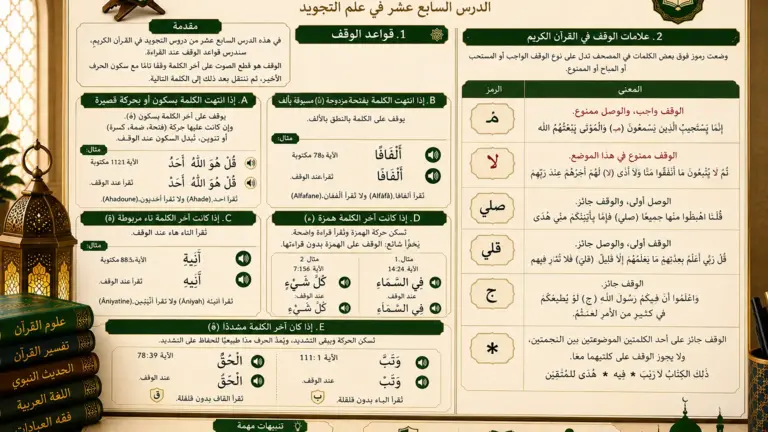
1. Essential Quranic Stop Signs - الْوَقْفُ الَّازِم
Stop that allows the sentence to be complete grammatically and in terms of meaning.
This stop is called "perfect" because the speech is complete and independent of what is after it.
He is represented in the mushaf by a small meem:

Example:
إِنَّمَا يَسْتَجِيبُ الَّذِينَ يَسْمَعُونَ ۘ وَالْمَوْتَىٰ يَبْعَثُهُمُ اللَّهُ ثُمَّ إِلَيْهِ يُرْجَعُونَ
Only those who hear will respond. But the dead - Allah will resurrect them; then to Him, they will be returned. (6:36)
2. Allowable Quranic Stop Signs - الْوَقْفُ الْجَائِز
This marks a point where stopping or continuing is permissible, with neither option taking precedence. You can identify it in the mushaf by a small Arabic letter "jeem"  or, in certain editions, "
 "
"
Example:
فَسَبِّحْ بِحَمْدِ رَبِّكَ وَاسْتَغْفِرْهُ ۚ إِنَّهُ كَانَ تَوَّابًا
Then exalt [Him] with praise of your Lord and ask forgiveness of Him. Indeed, He is ever Accepting of repentance. (110:3)
3. Favorable Quranic Stop Signs - الْوَقْفُ الْحَسَن
Stop that allows the sentence to be complete grammatically and in terms of meaning.
This stop is called "perfect" because the speech is complete and independent of what is after it.
He is represented in the mushaf by a small meem:
Example:
إِنَّمَا يَسْتَجِيبُ الَّذِينَ يَسْمَعُونَ ۘ وَالْمَوْتَىٰ يَبْعَثُهُمُ اللَّهُ ثُمَّ إِلَيْهِ يُرْجَعُونَ
Only those who hear will respond. But the dead - Allah will resurrect them; then to Him, they will be returned. (6:36)
Commonly referred to as the "Preferred Continuation Stop, " this signifies a point where stopping or continuing is permissible, but the preference leans toward continuation. It bears this name because halting at this juncture still maintains the comprehensibility of the meaning. In the mushaf, it's symbolized by the Arabic letters "sad"  and "lam, " or in some versions, "
 "
"
Example:
كَلَّا ۖ لَيُنبَذَنَّ فِي الْحُطَمَةِ
No! He will surely be thrown into the Crusher. (104:4)
4. Recommended Quranic Stop Signs - الوَقْفُ الْكَافِي
Commonly known as the "Preferred Pausing Stop, " this signifies a point where both stopping and continuing are permissible, yet the preference is for stopping. It derives its name from the understanding that halting here enhances comprehension. In the mushaf, it is denoted by the combination of the Arabic letters "qâf"  and "lâm, " or in some editions, "
 ".
".
Example :
إِذَا جَاءَكَ الْمُنَافِقُونَ قَالُوا نَشْهَدُ إِنَّكَ لَرَسُولُ اللَّهِ ۗ وَاللَّهُ يَعْلَمُ إِنَّكَ لَرَسُولُهُ وَاللَّهُ يَشْهَدُ إِنَّ الْمُنَافِقِينَ لَكَاذِبُونَ
When the hypocrites come to you, [O Muhammad], they say, "We testify that you are the Messenger of Allah." And Allah knows that you are His Messenger, and Allah testifies that the hypocrites are liars. (63:1)
5. Sequential Quranic Stop Signs - الْوَقْفُ الْمُتَقَدِمَيْن
These are two adjacent stopping points, and you must choose only one of them to pause. They are indicated in the mushaf by three small dots  positioned closely together: at two closely situated spots.
For example:
ذَٰلِكَ الْكِتَابُ لَا رَيْبَ ۛ فِيهِ ۛ هُدًى لِّلْمُتَّقِينَ
This is the Book about which there is no doubt, a guidance for those conscious of Allah - (2:2)
6. Forbidden Quranic Stop Signs - الوَقْفُ الْمَمْنُوع
This signifies a point where stopping is strictly forbidden because doing so would render the sentence incomplete and the meaning incomprehensible. What comes before this point relies on what follows it both grammatically and contextually. In the Quranic text, it is symbolized by the letters "lam" and "alif":  .
.
Example:
وَالْمُؤْمِنُونَ ۙ وَلِيَقُولَ الَّذِينَ فِي قُلُوبِهِم مَّرَضٌ
and the believers will not doubt and that those in whose hearts is hypocrisy (74:3)
Conclusion
This Tajweed rules lesson has concluded. Insha'Allah, the next lesson will cover the stop in front of إلا and وَلَكِن in the Holy Quran.
At the Al-dirassa Institute, we provide an accessible path to mastering Tajweed under the guidance of skilled instructors. Should you wish to pursue this further, we warmly invite you to reach out to us.
Book your free trial of 30 minutes
Registration form

No Comments
No comments yet.
No comments yet.