
When engaging in the profound act of reading the Holy Quran, it's essential to understand that one cannot simply pause at any moment. Therefore, it is crucial to acquaint oneself with the various forms of stops that guide this sacred practice.
This aspect of Quranic reading holds immense significance as it can greatly influence the interpretation of the Holy Quran. A poorly executed stop can either convey a distorted message or, in some cases, render the text devoid of meaning. Similarly, the resumption of reading after a pause is equally important, and to aid in this process, scholars have devised a system of symbols to facilitate comprehension.
-
Al-Waqf (The Pause): Al-Waqf is a moment of silence that occurs at the end of a word, allowing the reader to catch their breath and seamlessly continue their reading.
-
Al-Qat' (The Stop): As the name implies, Al-Qat' represents a deliberate interruption in reading or recitation. This pause enables the reader or reciter to attend to other activities, such as adjusting their posture during prayer or tending to any other necessary tasks.
-
As-Sakt (Silence): As-Sakt is a slight vocal pause that lasts slightly less than a waqf (pause). During this pause, the reciter refrains from taking a breath but continues with their reading.
To delve deeper into the concept of stops, we can explore the various types of Al-Waqf:
-
Al-Waqf al-Idtirari (The Forced Break): This type of waqf signifies a pause that occurs naturally due to the structure of the text, compelling the reader to pause involuntarily.
-
Al-Waqf al-Intidhari (The Waiting Break): In this category, the reader pauses intentionally, awaiting a suitable moment to continue reading.
-
Al-Waqf Ikhtibari (The Experimental Pause): The reader employs this form of waqf to experiment with different stops and evaluate their impact on the text's meaning and flow.
-
Al-Waqf Ikhtiyari (The Free Break): The free break, or voluntary stop, is a pause initiated by the reader's discretion without any external compulsion. There are four subtypes of the free break:
-
Full Stop: A complete and definitive pause, often marking the end of a verse or passage.
-
The Sufficient Stop: A pause that provides a suitable break in the text, allowing for comprehension and reflection without necessarily concluding a thought or idea.
-
The Correct Stop: This pause aligns with the natural flow of the text, enhancing understanding and clarity.
-
The Bad Stop: A pause that disrupts the text's coherence and meaning, often due to its inappropriate placement or length.
-
In summary, a deep understanding of these different forms of stops, particularly in the context of Al-Waqf, is crucial for a meaningful and accurate reading of the Holy Quran. Properly executed stops and pauses not only aid in maintaining the sacredness of the text but also ensure that its message is conveyed with precision and reverence.
1. The full stop - الْوَقْفُ التَّام
This particular type of stop stands as an autonomous semantic unit within the text, and its significance remains intact without any reliance on what follows in terms of meaning or grammatical connection. It possesses an inherent completeness that allows for a momentary pause, and one can seamlessly resume reading or recitation without any disruption in comprehension or flow.
Example:
أُولَـٰئِكَ عَلَىٰ هُدًى مِّن رَّبِّهِمْ ۖ وَأُولَـٰئِكَ هُمُ الْمُفْلِحُونَ
Here you mark a break. Then you continue إِنَّ الَّذِينَ كَفَرُوا in Sura al baqara between verses 5 and 6.
2. The sufficient stop - الْوَقْفُ الكَافِي
This is a pause characterized by a self-contained meaning that, while complete in itself, holds relevance to what follows in a broader context, even though it may not have a direct grammatical connection to the subsequent text.
As such, it is entirely permissible to pause briefly and then continue without hesitation.
For instance:
سَوَاءٌ عَلَيْهِمْ أَأَنذَرْتَهُمْ أَمْ لَمْ تُنذِرْهُمْ لَا يُؤْمِنُونَ
Here, you initiate a pause, after which you seamlessly proceed to commence the next verse:
خَتَمَ اللَّهُ عَلَىٰ قُلُوبِهِمْ وَعَلَىٰ سَمْعِهِمْ ۖ وَعَلَىٰ أَبْصَارِهِمْ غِشَاوَةٌ ۖ وَلَهُمْ عَذَابٌ عَظِيمٌ
3. The correct stop - الْوَقْفُ الحَسَنُ
This represents a unique pause, one where the meaning it carries is self-contained and yet intricately intertwined with both the subsequent grammatical structure and the overarching context.
For instance:
الْحَمْدُ لِلَّهِ
Indicate a pause, briefly halt, then seamlessly resume.
رَبِّ الْعَالَمِينَ
Pausing is permissible, but an immediate resumption is not.
Therefore, we must backtrack and continue, unless the pause occurs at the end of a verse. It's worth noting that the Prophet (peace be upon him) would halt at the end of each verse before continuing.
For instance:
الْحَمْدُ لِلَّهِ رَبِّ الْعَالَمِينَ
stop
الرَّحْمَـٰنِ الرَّحِيمِ
stop
مَالِكِ يَوْمِ الدِّينِ
stop
إِيَّاكَ نَعْبُدُ وَإِيَّاكَ نَسْتَعِينُ
Indicate the stop, then promptly proceed with the continuation.
4. The bad stop - الْوَقْفُ القَبِيح
This is a discernment marked by an incomplete meaning or the potential for misinterpretation, which may result in an inaccurate or unfavorable understanding.
For instance:
يَا أَيُّهَا الَّذِينَ آمَنُوا لَا تَقْرَبُوا الصَّلَاةَ
stop
وَأَنتُمْ سُكَارَىٰ
Hence, it is not permissible to pause unless it's due to an essential necessity, such as the need to catch one's breath. In such instances, you must retrace your steps to facilitate a seamless resumption and continuation of the reading.
Conclusion
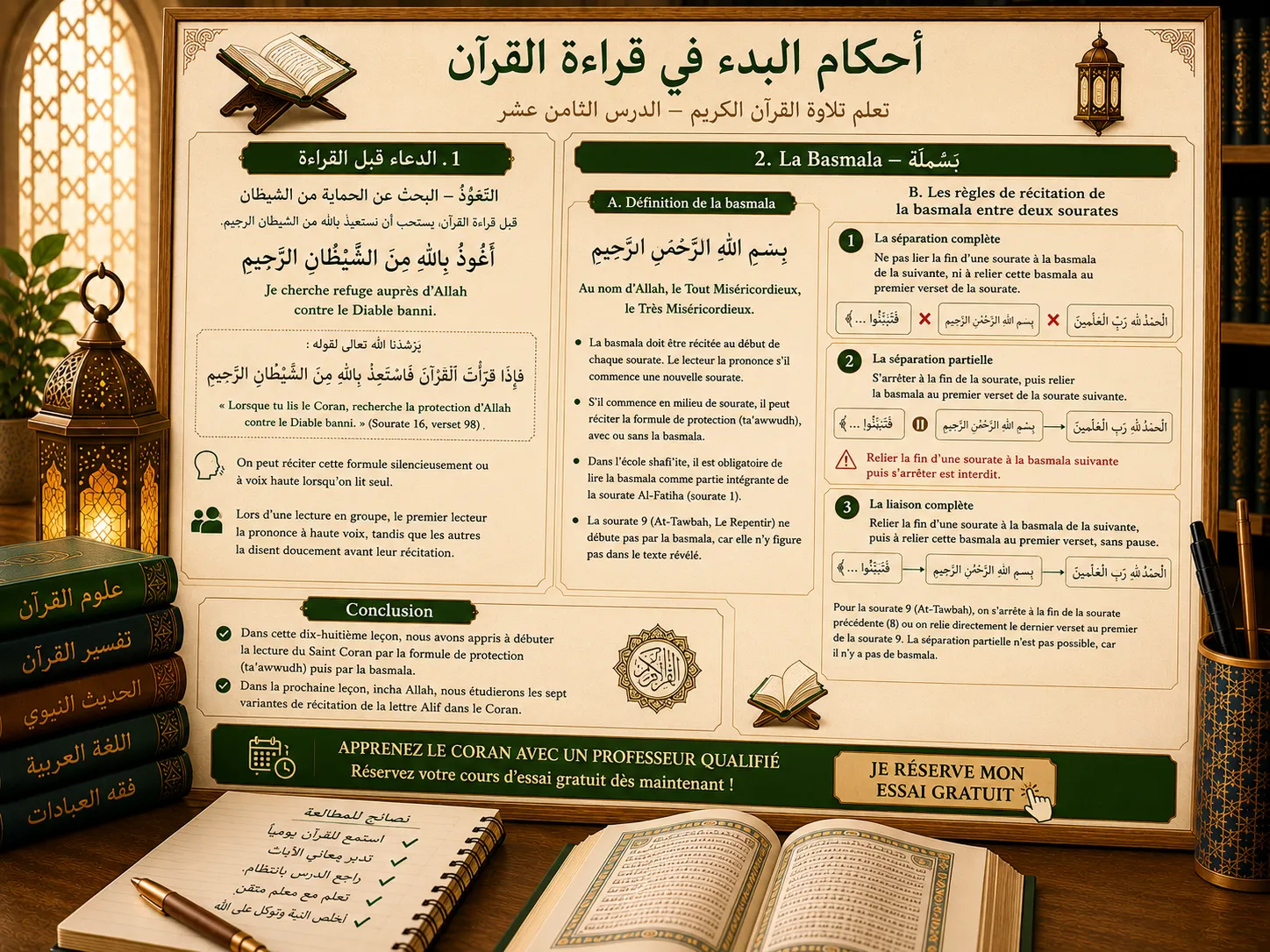
This Tajweed rules lesson has concluded. Insha'Allah, the next lesson will cover the rules of the rules of the silence.
At the Al-dirassa Institute, we provide an accessible path to mastering Tajweed under the guidance of skilled instructors. Should you wish to pursue this further, we warmly invite you to reach out to us.



No Comments
No comments yet.