
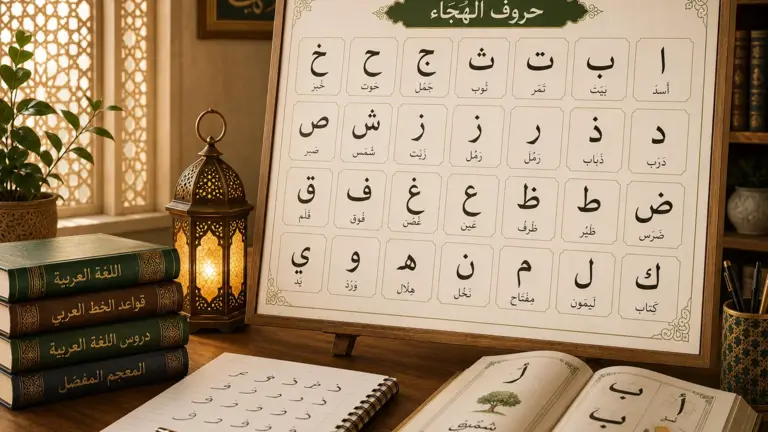
Are you intrigued by the idea of learning new languages? Have you set your sights on mastering the Arabic Alphabet?
Congratulations on taking a pivotal step towards understanding the Arabic script. Contrary to popular belief, the Arabic language, although intricate, can be learned swiftly. With the right approach, you'll be amazed at how rapidly you can progress.
While the Latin alphabet is familiar to English speakers, the Arabic script presents unique characteristics. Notably, it is read and written from right to left, comprising 28 letters and a range of special characters and vowels that vary based on word context. This richness adds depth to the language, but with attentive learning, you can navigate its nuances.
At first glance, the Arabic script might appear daunting. Yet, with a strong foundation and consistent practice, it's simpler than it seems. One key distinction is that Arabic doesn't differentiate between upper and lower-case letters. Instead, the shape of each letter morphs based on its position within a word — whether at the beginning, middle, end, or standing alone.
1. Mastering the Arabic Script: A Guide to Writing the Alphabet
Kickstarting Your Arabic Journey: Essentials of the Alphabet for Beginners
- The Arabic script consists of 28 distinct letters.
- Each letter can take different shapes based on its position within a word.
- Short vowels are infrequently used in Arabic writing.
- Every Arabic letter has a singular foundational shape.
- Unlike English, Arabic doesn't differentiate between uppercase and lowercase letters.
The Arabic script is written in a flowing cursive manner
When writing in Arabic, the script flows in a cursive style, connecting all the letters seamlessly.
The Arabic alphabet is traditionally written in a right-to-left direction
Writing the Arabic alphabet can be made easier for beginners by adopting a technique that involves pushing the pen rather than pulling it, which encourages a more natural hand movement.
Arabic employs an alphabet, not pictograms or hieroglyphics, and the number of shapes you need to learn is relatively minimal, making mastery faster than many other languages.
Correct Pen Handling Technique
Enhance your writing fluidity by adopting a fingertip grip on the pen. This provides better mastery, especially for intricate letters.
Enhancing Wrist Flexibility
Here are some effective strategies for improving your Arabic alphabet writing skills:
- Wrist Flexibility Practice: Make clockwise loops from right to left daily.
- Continuous Writing: Write words without lifting the pen to improve flow.
- Right-to-Left Transition: Practice adapting to the right-to-left writing pattern.
- Repetition: Repeat each letter to build muscle memory.
2. Discovering the Arabic Alphabet
In this online Arabic learning lesson, with the grace of Allah, we will delve into the Arabic alphabet. This lesson is structured to:
- Familiarize you with the names of the Arabic letters, presented phonetically.
- Provide audio recordings for correct pronunciation.
- Enable recognition of the names and shapes of all 28 letters.
NOTE: The following six letters never connect with the letter after them: و ز ر ذ د أ
Arabic Alphabet Table
| Letter | Transliteration | Audio |
|---|---|---|
| أ | Alif (A/oo/ee) | |
| ب | Ba (B) | |
| ت | Ta (T) | |
| ث | Tha (Th) | |
| ج | Jim (J) | |
| ح | Ha (No equivalent) | |
| خ | Kha (Kh) | |
| د | Dal (D) | |
| ذ | Dhal (Th, voiced) | |
| ر | Ra (Rolled R) | |
| ز | Zay (Z) | |
| س | Seen (S) | |
| ش | Sheen (Sh) | |
| ص | Saad (Emphatic S) | |
| ض | Daad (Emphatic D) | |
| ط | Tta (Emphatic T) | |
| ظ | Tha (Emphatic Th) | |
| ع | Ayn (No equivalent) | |
| غ | Ghayn (No equivalent) | |
| ف | Fa (F) | |
| ق | Qaf (Deep K) | |
| ك | Kaf (K) | |
| ل | Lam (L) | |
| م | Meem (M) | |
| ن | Noon (N) | |
| ه | Ha (H, home) | |
| و | Waw (W) | |
| ي | Ya (Y) |
Conclusion
In our upcoming lesson, we'll explore short vowel marks in the Arabic language, inshaAllah.
If you're searching for the ideal platform to learn this language effortlessly, your search ends at al-dirassa.com. Here, you'll find top-notch tutors and structured courses to help you master Arabic efficiently.
Book your free trial of 30 minutes
Registration form

No Comments
No comments yet.
No comments yet.