
Introduction
In this fourteenth lesson on learning the Tajweed rules of the Holy Quran, we continue our study of elongation rules. Here, we will examine the elongations that are followed by the letter Hamza.
There are two types of elongation caused by the letter Hamza — ء:
- The obligatory connected elongation — مَدٌّ مُتَّصَلٌ واجِبٌ
- The permissible separated elongation — مَدٌّ مُنْفَصِلٌ جائِزٌ
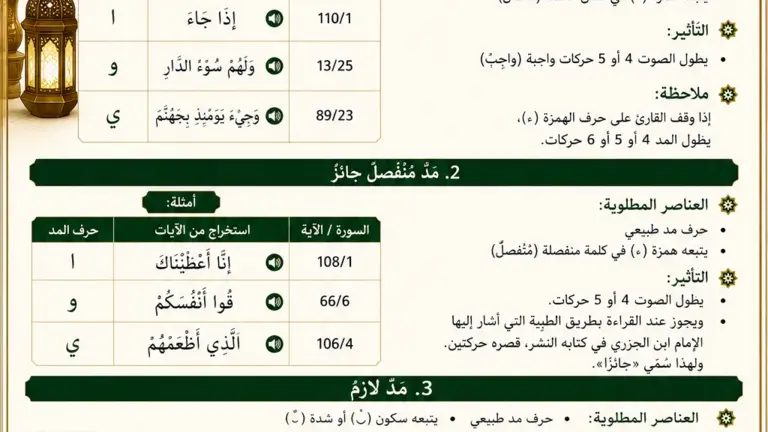
1. The Obligatory Connected Elongation — مَدٌّ مُتَّصَلٌ واجِبٌ
Required elements:
- A natural elongation
- Followed by the letter Hamza — ء — in the same word (مُتَّصَلٌ)
Effect:
- The sound is elongated for 4 or 5 obligatory counts (واجِبٌ)
Additional note:
If the recitation stops on the Arabic letter Hamza — ء — the elongation may be extended for 4, 5 or 6 counts.
Examples:
| Elongation Letter | Verse Excerpt | Surah / Verse |
| ا | إِذَا جَاءَ |
110:1 |
| و | وَلَهُمْ سُوءُ الدَّارِ |
13:25 |
| ي | وَجِيءَ يَوْمَئِذٍ بِجَهَنَّمَ |
89:23 |
2. The Permissible Separated Elongation — مَدٌّ مُنْفَصِلٌ جائِزٌ
Required elements:
- A natural elongation
- Followed by the Arabic letter Hamza — ء — in a separate word (مُنْفَصِلٌ)
Effect:
- The sound is elongated for 4 or 5 counts
- However, according to the recitation path of Tayyibah mentioned by Imam Ibn Al-Jazari in his work An-Nashr, it is permissible to shorten it to two counts. This is why it is called “permissible” — جائِزٌ
Examples:
| Elongation Letter | Verse Excerpt | Surah / Verse |
| ا | إِنَّا أَعْطَيْنَاكَ |
108:1 |
| و | قُوا أَنفُسَكُمْ |
66:6 |
| ي | الَّذِي أَطْعَمَهُم |
106:4 |
Conclusion
We have learned how to recite elongations followed by the Arabic letter Hamza, both within the same word and between two separate words.
These elongations are important, and some of them are obligatory, so they must be observed carefully.
In the next lesson, insha’Allah, we will learn how to recite elongations followed by a sukun or a shadda.
Book your free trial of 30 minutes
Registration form




No Comments
No comments yet.
No comments yet.