
- Institut Al-Dirassa
- No comments
Arabic, a language with a rich history and cultural significance, offers an ocean of opportunities to those who dive deep into its intricate grammar, extensive vocabulary, and fluid script. If you ar…

- Institut Al-Dirassa
- No comments
Introduction Nabr in Tajweed refers to a subtle elevation of the voice and is identified in five distinct forms, particularly when accompanied by Madd al Lazeem (an elongation followed by a shedda). 1…

- Institut Al-Dirassa
- No comments
In the intricate science of Tajweed, certain verses hold particular recitation rules that magnify the eloquence of the Qur'an. Notably, when a verse commences with إِلَّا or وَلَكِن, two Sunnah practi…
- Institut Al-Dirassa
- No comments
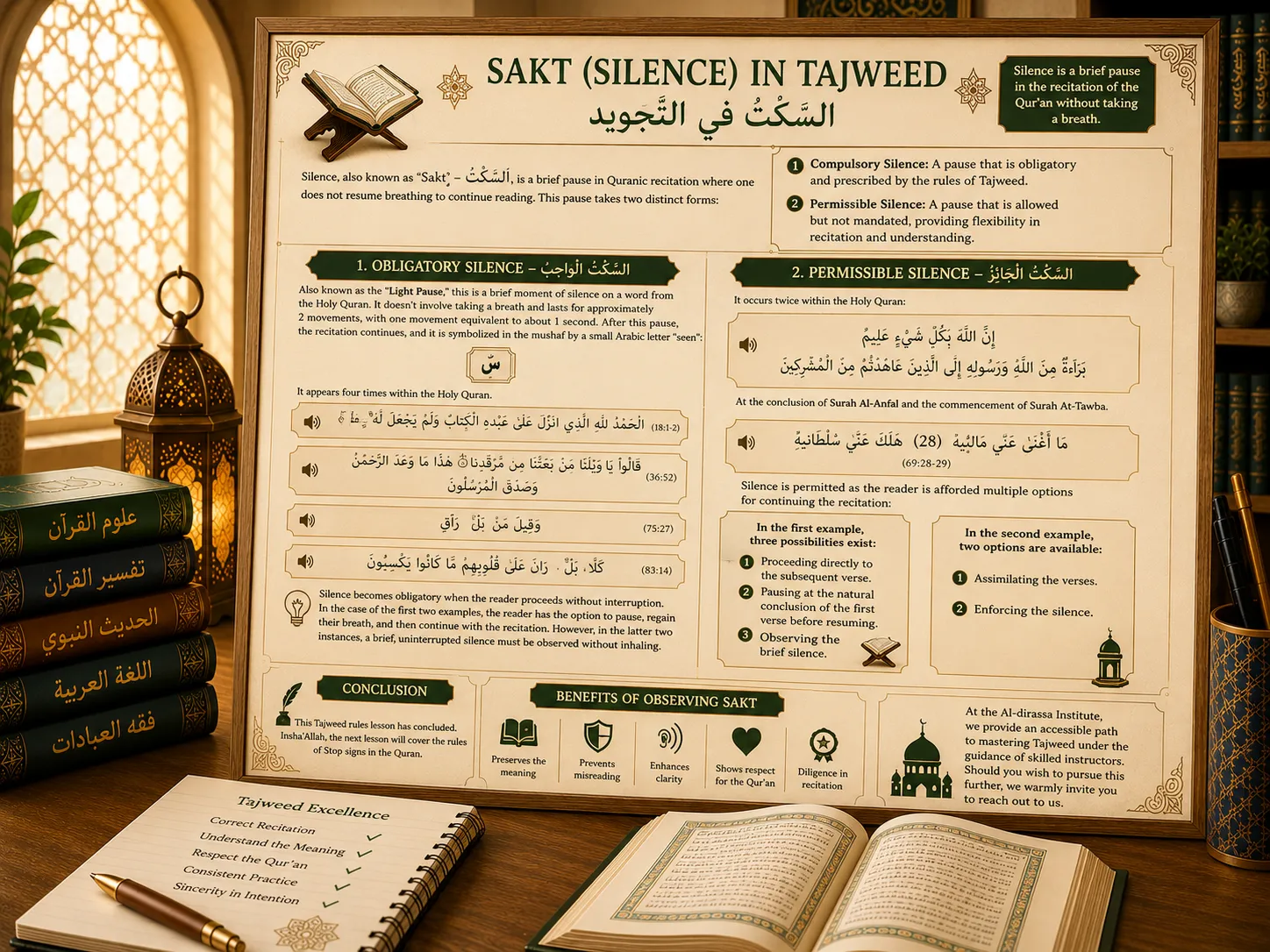
Silence, also known as 'Sakt' - السَّكْتُ, is a brief pause in Quranic recitation where one does not resume breathing to continue reading. This pause takes two distinct forms: Compulsory Silence: A p…

- Institut Al-Dirassa
- No comments
1. Uthman ibn Affan nickname 'Uthman ibn Affan was one of the earliest individuals to embrace Islam, accepting it shortly after the first revelation to the Prophet ﷺ. He ascended to the position of Ca…

- Institut Al-Dirassa
- No comments
Qalqala: Resonance in Arabic Pronunciation In the Arabic language, "qalqala" is a term that evokes a sense of restlessness, instability, and disturbance. Interestingly, this concept is not only lingui…

Recent articles
-
 June 10, 2026
Al isti’adha and al basmala | Tajweed rules
-
 June 10, 2026
Understanding the Role of Alif | Free Tajweed Lesson
-
 June 9, 2026
Online Quran Memorization: Is It Really Possible?
-